Rosemary Parmesan Artisan Bread
The first time I baked this rosemary-and-Parmesan loaf I had nothing planned except a loaf pan and a sharp knife. I ended up learning more about tempering cheese, how gentle folding makes a loaf light, and the exact moment when rosemary moves from herb to aroma. Back then I used a heavy pot; if you…
The first time I baked this rosemary-and-Parmesan loaf I had nothing planned except a loaf pan and a sharp knife. I ended up learning more about tempering cheese, how gentle folding makes a loaf light, and the exact moment when rosemary moves from herb to aroma. Back then I used a heavy pot; if you prefer that approach, my notes echo some techniques similar to the Dutch-oven garlic-rosemary bread technique I bookmarked.
Ingredients (what I keep on the counter)
- About 1½ cups of water, at room temperature (around 70°F / 21°C).
- A scant teaspoon of active dry yeast to kick things off.
- Three and a half cups of strong bread flour, with a little extra nearby for dusting.
- A teaspoon of salt — I like kosher or fine sea salt.
- Two tablespoons of rosemary, very finely chopped so it distributes.
- Roughly 1½ cups of Parmesan cut into small cubes (or little chunks if you’re using a firmer aged cheese).
Mixing and feel: I rarely weigh things mid-recipe; I go by touch. Stir the yeast into the water so it dissolves, then add most of the flour and the salt. The dough should be tacky but not a batter: when I pull a finger through it the dough stretches slightly and clings. Fold in the chopped rosemary and the cubed cheese toward the end so the pieces stay distinct instead of melting into oblivion.
There are two schools of thought here — long, slow fermentation or a quicker rise at a warmer temperature. I prefer at-leisure fermentation because it deepens the flavor: after the initial mix I cover the bowl and leave it at room temperature to rise until doubled. If you’re in a hurry, a warmer spot and a bit of yeast will shorten that; you can also adapt the dough to a skillet technique I sometimes use when I don’t want to heat the oven, inspired by a rustic skillet garlic-rosemary loaf I like to read for ideas about browning.
Shaping is forgiving with this formula. I turn the dough out onto a floured surface, do a gentle envelope fold, let it rest ten minutes, then tighten the surface tension lightly with my hands. If I’m using a Dutch oven, I preheat the pot with its lid inside the oven so the crust gets that initial steam burst. For an easier shortcut, baking on a preheated stone or even under a tray of water in the oven produces a good crust. Sometimes I crisp thin slices in an air fryer before serving; when I want that ultra-fast toasty finish I reference a handy 10-minute air-fryer garlic bread idea for timing.
Temperature and timing notes (short and to the point)
- Oven: Very hot at the start — the initial high heat gives oven spring; lower the temperature slightly after the first 10–15 minutes if the loaf is browning too fast.
- Bake length: depends on shape. A boule in a Dutch oven usually needs about 25–35 minutes total; a loaf on a baking stone may run a little longer.
- Internal doneness: I tap the bottom of the loaf — it should sound hollow — and aim for an internal temperature near 200°F (93°C) if I use a thermometer.
Tips I keep returning to
- Cube your cheese rather than grating if you want pockets of molten Parmesan rather than a uniformly cheesy crumb.
- Chop rosemary very fine; whole needles can be sharp and pull out of the crumb.
- Dusting with extra flour right before scoring means you can see your pattern clearly after the oven bloom.
- If you’re worried about the cheese on top burning, tent the bread loosely with foil for the last 5–10 minutes.
Variations I experiment with
- Swap part of the bread flour with whole wheat for a nuttier bite; reduce water slightly because whole grains absorb more. I once tried 25% whole wheat and liked the texture, though the rise was a touch slower.
- Add a teaspoon of honey to the initial mix for a lightly sweet crust.
- For a garlicky twist, fold in a couple of cloves of roasted garlic with the cheese before the second rise.
Serving and storage
Short-term: I slice and serve the loaf warm with butter; the cheese pockets make it great with olives or a simple tomato salad.
To store: wrap cooled bread in a clean kitchen towel or keep in a paper bag for a day; for longer storage I slice and freeze, then refresh slices in a hot oven or air fryer. Reheating briefly at high heat crisps the crust and loosens the cheese.
A quick narrative of one bake
I remember scoring a tight cross on the crust, expecting a dramatic oven bloom. The loaf did bloom — but not symmetrically; a chunk of cheese near the edge forced a rogue expansion and I loved the rustic look. Texture was soft yet carrying little islands of Parm. The rosemary perfume was the star. It was imperfect and exactly what I wanted.
Conclusion
If you want alternate step-by-step inspirations, I sometimes compare my notes to the Harvest & Nourish no-knead rosemary Parmesan guide for no-knead timing. For a crust-focused, Dutch-oven-centered approach I also look at the Practical Kitchen’s crusty rosemary-Parmesan bread tutorial for scoring patterns and oven tricks. And when I’m after a slightly different flavor profile and handling tips, the Tao of Spice Dutch oven rosemary-Parmesan recipe has useful diagrams that I occasionally borrow from. One limitation I discovered while preparing this loaf is that the Parmesan can encourage a slightly darker bottom crust if the pot or stone is very hot, so I now watch that first 10 minutes closely and tent when necessary.
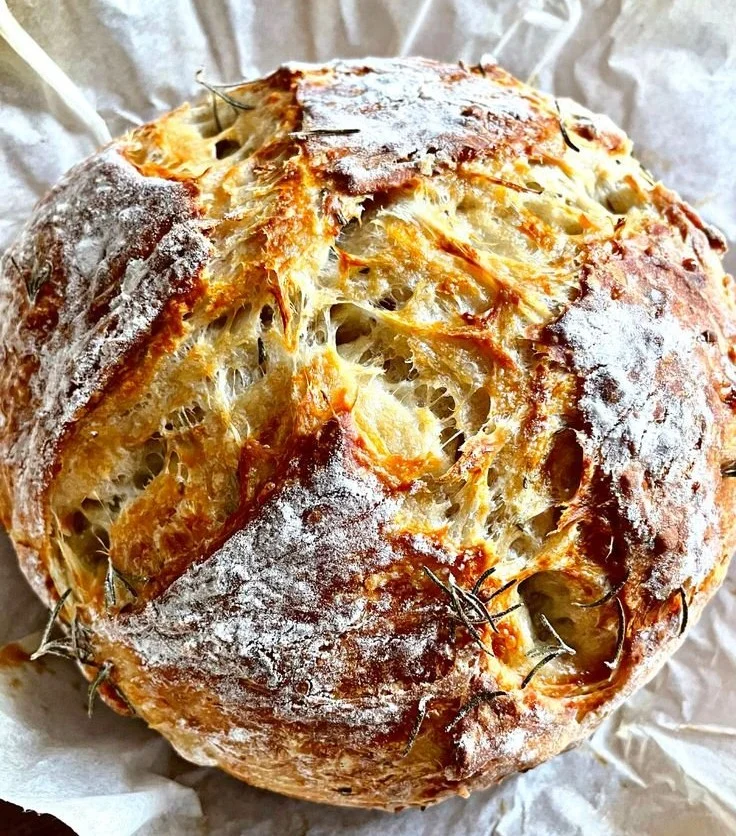
Rosemary and Parmesan Loaf
Ingredients
Method
- Stir the yeast into the water so it dissolves.
- Add most of the flour and the salt.
- The dough should be tacky but not a batter.
- Fold in the chopped rosemary and cubed cheese towards the end.
- Cover the bowl and let it rise at room temperature until doubled in size.
- Optionally, for a quicker rise, find a warmer spot and add a bit more yeast.
- Turn the dough out onto a floured surface and perform a gentle envelope fold.
- Let it rest for ten minutes, then tighten the surface tension lightly.
- Preheat the Dutch oven (if using) with its lid inside to create steam.
- Bake until the loaf is golden brown, about 25-35 minutes.
- For a loaf on a baking stone, it may take a little longer.