Watermelon Smoothie Bowl
I never set out to make a photograph-ready breakfast; I just wanted something that tasted like summer and didn’t take a lot of thinking. After a few experiments I settled on a lively, pink bowl that feels like a drink and a snack at the same time. That first paragraph is also where I admit…
I never set out to make a photograph-ready breakfast; I just wanted something that tasted like summer and didn’t take a lot of thinking. After a few experiments I settled on a lively, pink bowl that feels like a drink and a snack at the same time.
That first paragraph is also where I admit I glanced at a slightly different watermelon bowl I bookmarked for inspiration, then promptly ignored proportions and made it mine.
Ingredients (my shorthand)
- about two cups of cubed, seedless watermelon (I prefer it very ripe)
- one frozen banana (keeps the texture thick and creamy)
- roughly half a cup of plant-based milk — almond works, oat is silkier
- a tablespoon of tiny chia seeds for body and a subtle nutty bite
- toppings: crunchy granola, toasted coconut flakes, and a scatter of fresh berries or kiwi for contrast
Why I freeze the banana (and sometimes the watermelon)
I started leaving a banana in the freezer for smoothies and quickly learned it’s indispensable. It gives structure without ice crystals. Sometimes I freeze a few watermelon chunks too, but that makes the blender work harder; when I do that I add a splash more milk. The texture becomes almost ice-cream-like if I’m feeling indulgent.
How I make it (no rigid steps, just how my routine flows)
I toss the frozen banana and watermelon into the blender first so the blades get traction. Then I pour in the plant milk and sprinkle the chia seeds over everything. I pulse a few times, then run it until the surface looks glossy and no chunks remain. If the mixture is stubbornly thick I add a tablespoon more milk; if it’s too runny I toss in a couple more frozen pieces and pulse until it firms up. I aim for a spoon-able texture — not soup, not sorbet.
Assembly and toppings
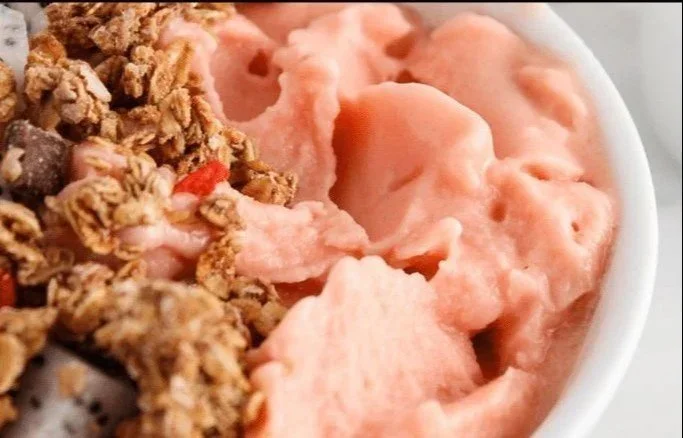
I ladle the smoothie into a bowl, letting the pale pink settle. Crunch is essential: a scattering of granola gives me that satisfying contrast, and coconut flakes add a toasty whisper. Fresh fruit finishes it — a few halved berries or sliced kiwi for brightness. If I want a little chew or a protein kick I stir an extra sprinkle of chia into the top layer rather than blending it all, so there’s a speckled texture.
A few variations I like
- If I’m craving something creamier I’ll swap almond for oat milk and add a spoonful of cashew butter.
- For a tropical twist I’ll use coconut yogurt as part of the liquid and top with mango. I sometimes look at acai and coconut bowl inspiration to nudge my flavor combinations in new directions.
- To boost protein I fold in a scoop of plain plant protein powder and reduce the milk by a splash.
Timing, storage, and leftovers
This bowl is best eaten immediately. If I run out of time I’ll store the blended base in a sealed jar in the fridge for up to 24 hours, but it invariably loses some of its effervescence and bright color — the chia will continue to swell, thickening the mixture. Re-blending with a splash of milk revives it, though the texture is never quite the same.
Little experiments that mattered
Once I added the chia seeds after blending and the top stayed pleasantly grainy; another time I let the mixture sit for ten minutes and the chia gave a pudding-like body. Both are fine; it depends whether I want chew or silk. Also, a blender with a strong motor yields a silkier finish; my old one left tiny fibrous bits from the watermelon rind even when I trimmed carefully.
Quick FAQ (short answers)
- Can I use honey or maple? Yes, but I avoid extra sweeteners when the watermelon is very ripe.
- What if my blender overheats? Pause, scrape down the sides, add more liquid, and pulse. A rested motor is a happy motor.
- Can I omit chia? You can, though the mouthfeel will be lighter and less filling.
A note about proportions
I rarely measure things obsessively, which explains why each bowl I make tastes slightly different. Two cups of fruit to half a cup of milk is my rough ratio; the banana and frozen bits are the variables that determine whether the bowl leans toward smoothie or soft-serve.
Final warm-up before you serve: taste a spoonful. Adjust. Add tiny bits (a squeeze of lime, a pinch of salt) to sharpen or mellow flavors. I like the pinch of salt trick; it wakes up the sweetness in a subtle way.
Conclusion
If you’d like alternative presentations and more photos, I compared my method with Watermelon Smoothie Bowl – The Hint of Rosemary and found a few plating ideas that stuck with me. For a slightly different ingredient list and technique, I also referenced Watermelon Smoothie Bowl – Yum Vegan Lunch Ideas while refining my proportions. And when I wanted a creamier, more tropical spin, Watermelon Smoothie Bowl – Plant Based Jess offered ideas I adapted into my toppings. One limitation I noticed during preparation: if the watermelon isn’t very sweet, the bowl can taste flat, so choose fruit at its peak for the best result.
Watermelon Smoothie Bowl
Ingredients
Method
- Add the frozen banana and watermelon to the blender first for better traction.
- Pour in the plant-based milk and sprinkle the chia seeds over the mixture.
- Pulse a few times, then blend until the mixture is glossy and smooth.
- If the mixture is too thick, add a tablespoon more milk; if too runny, add a few more frozen pieces.
- Ladle the smoothie into a bowl.
- Top with granola, coconut flakes, and fresh fruit.
- Optionally, stir an extra sprinkle of chia seeds for added texture.